Human Enablement & AI Enablement
 Chris
Chris 
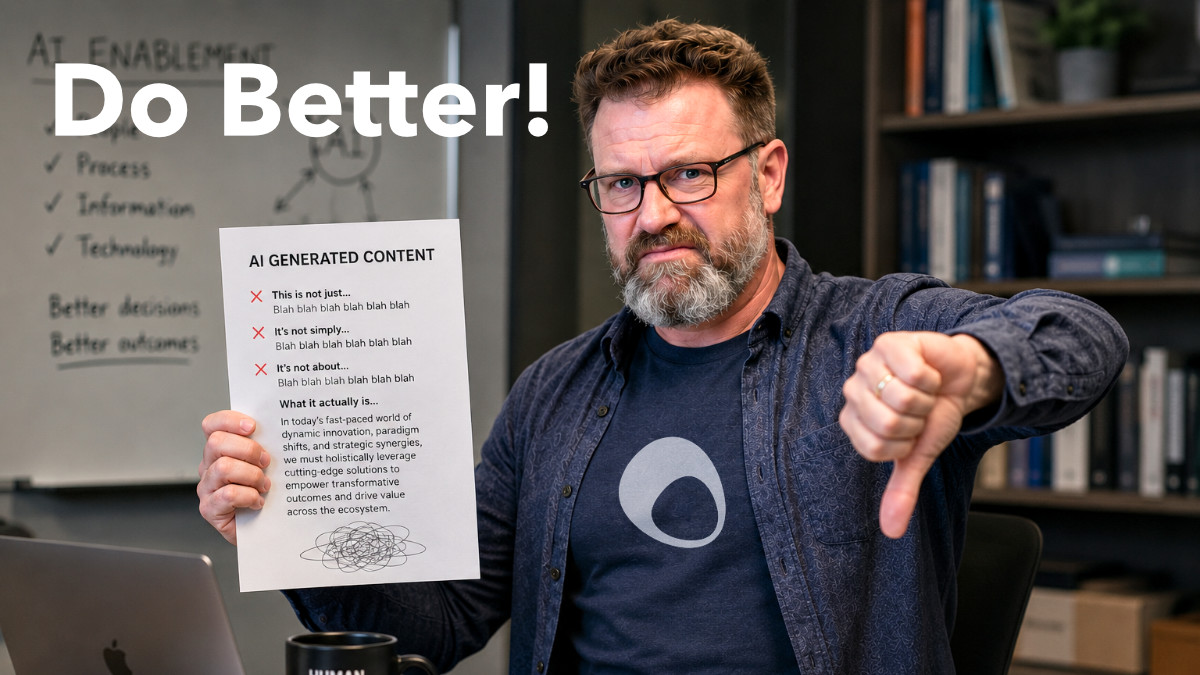
Human-curation of AI-generated content is the new norm for drafting quality governance documentation.
If there is one thing I can’t stand, it’s AI generated content.
It’s used for YouTube videos that go on and on, repeating variations of the same limited information without saying anything of value. You see it used for bot comments on LinkedIn, as well as LinkedIn posts. You’ve got to wonder about the value in AI bots commenting on AI bot-generated content.
AI content is easy to spot once you recognise the same language patterns being used over and over again. The one pattern that irks me the most is when AI starts saying "what something is not" three times, before using word salad to make a pseudo-revelation. If you’re not really listening, it just seeps into your subconscious. If you engage your brain and listen carefully, it’s words that reveal absolutely nothing. It is just mindless AI slop.
As much as I hate AI-generated content, I use AI to generate content every day!
Human Enablement
AI is fast becoming an essential tool in my writing arsenal. It is a game changer for technical writers. I'm using it to replace the expertise and knowledge that:
- has been lost from the organisation thanks to people moving on
- is unintentionally withheld by time-starved subject matter experts, or
- is deliberately withheld out of fear that sharing knowledge will undermine the expert's value to the organisation.
In my case, I'm not generating stories. AI enables me to update existing IT governance policies and to generate new policies and standards where none have been written. The AI provides me with information that would otherwise be difficult to obtain. Of course, curating and correcting these policies and standards as they are generated is important. On completion, the curated content enables AI to provide accurate information when someone in your business asks a question relating to the work they are performing.
AI Enablement
While AI content generation enables human productivity, human curation enables AI to better understand your business. With human-curated content, AI large language models:
- can correctly answer questions about your organisation's governance and operations, and
- won't need to fill in your organisations knowledge gaps with hallucinations.
Content Alignment
It's not all about content creation though. It is also about the alignment of new and existing content, for example:
- alignment of authority across your business's policies, standards, and current operations, and
- alignment with industry standards and legislation for compliance.
This in itself can be incredibly time consuming. With AI, multiple sources of information can be analysed and reported on in a less than two or three minutes. It of course takes a human longer to thoughtfully incorporate this feedback into the documentation that is being assembled, but what a time-saver AI can be!
The thing is, AI word-salad can still get through. That’s when you need another human to review the content. As any technical writer will tell you, it’s easy to reach the point where you can’t see the forest for the trees and you either require someone else to review your content, or you need to put it aside for a couple of weeks before revisiting it. The same applies to human-curated AI content. It’s easy to get too close and miss some of the AI slop that was generated.
When you compare what AI first generates to what is heavily human-curated AI content, the difference is huge.
Neither the AI, nor humans on their own can generate the same quality of content in the time it takes AI and humans working together to do it. Compare this approach with trying to:
- obtain the information from time-starved humans who don’t want to speak with you
- identify and manually trawl through brain numbing legislation and industry standards
- decipher what is valid when wading through the molasses of incomplete and out-dated organisational governance and operational documents
- write content that is easy to locate and digest by humans (and now AI), and
- align authority across all governance and operational documentation so that it all flies through an audit without any issues.
Human / AI Collaboration
Using AI is a collaborative effort. AI is filling in the role of a range of subject matter experts with human curation constantly questioning and evolving AI generated content until the information is correct and easy for readers to locate and digest.
In a business where subject matter experts are time-starved or non-existent, using AI as a subject matter expert is a sure-fire way of getting the job done.
It has to be repeated that human-curation of the content is absolutely essential. Using AI in this way can shorten a six-month first and incomplete draft down to a month with a comprehensive and almost complete draft. What you get is governance that is better quality thanks to AI’s ability to cross-reference multiple sources in seconds compared to months of doing it manually.
It’s not as straight forward as I make it sound. People are still required to review the documents, raise questions and have their issues addressed. Again, AI can be used to speed up the incorporation of feedback into the documentation.
If I was to summarise what I am saying, it is that non-curated AI generated content is absolute workslop. Properly human-curated AI content is the winner.
The more curated content you produce, the more reliable your organisation’s knowledge base becomes. The more reliable it becomes the less time will be spent going around in circles, duplicating effort and wasting other peoples' time. This results in productivity improvements across the organisation from setting strategy, to improvements in how work is done at the coal-face.
Curation starts with the outcome of the first prompt and continues to the very end of the project. Quality, cost and time are the winners because better quality content can be produced faster and more cheaply with:
- greater alignment of content to legislation and industry standards
- greater alignment of authority across governance and operational documentation
- duplication of content reduced to zero, and
- correctness of content and consistency of voice!
The thing to remember here is that despite AI's seemingly magical abilities to process information, it is still only a tool. Human curation is essential to producing quality documentation.
Want to know more?
Share this post with your colleagues and associates, and send me a message.
Categories: : AI Enablement, Governance, Operations